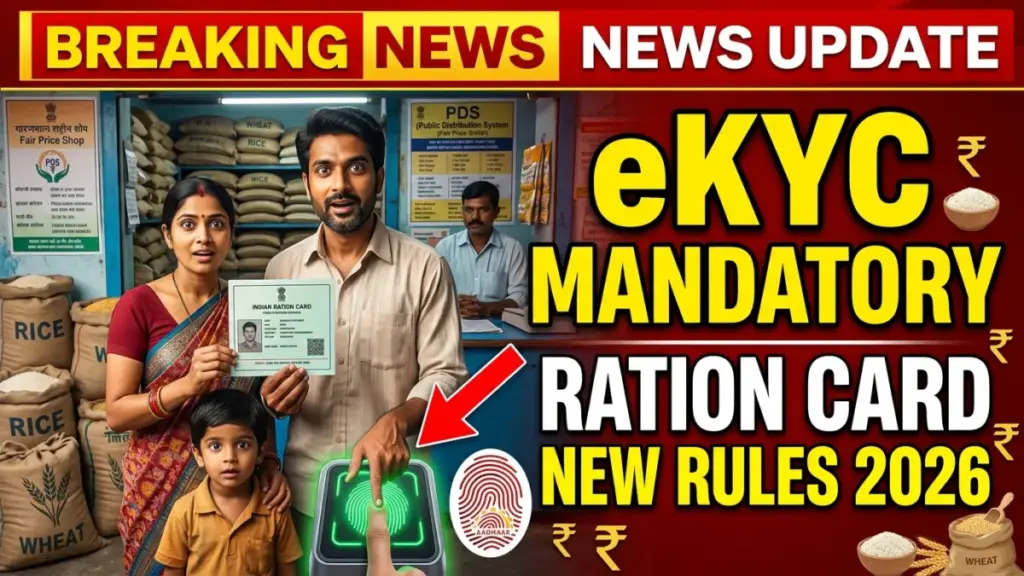
India’s Public Distribution System, which supports millions of households through subsidised food grains and essential commodities, is entering a new phase of administrative reform in 2026. Government authorities have begun tightening verification standards for ration card holders, with electronic identity confirmation, revised income limits and digital application systems becoming central to the process. The changes reflect a broader effort to modernise welfare databases and reduce duplication in beneficiary records.
Ration cards have long served as both an identity document and a gateway to subsidised food supplies under government schemes. Over time, however, inconsistencies in record keeping and outdated verification methods created gaps that policymakers have attempted to address through digitisation. According to reports and policy updates issued in recent months, the 2026 framework strengthens identity authentication and eligibility review while shifting most administrative procedures online.

In practical terms, households relying on ration benefits may need to ensure that their records are updated, Aadhaar authentication is completed and income details are correctly reported in official databases. While the reforms aim to improve transparency and reduce misuse, implementation may differ across states because ration card management remains largely under state government administration.
Aadhaar-Based eKYC Becomes Central to Beneficiary Verification
One of the most significant elements of the updated framework is the emphasis on electronic Know Your Customer verification. According to available documents, Aadhaar-linked eKYC is now expected to be completed for both existing ration card holders and new applicants. This authentication process helps confirm identity and remove duplicate entries from the Public Distribution System database.
Authorities believe the move could improve accuracy in identifying genuine beneficiaries. A senior policy observer familiar with welfare reforms noted that digitised verification allows “better tracking of households receiving subsidies while ensuring entitlements reach the intended population.” In some areas, however, challenges may arise if biometric verification equipment or internet connectivity is limited. As a result, timelines and implementation methods may vary depending on local infrastructure.
Revised Household Income Benchmarks Reshape Eligibility
The policy revision also includes updated income ceilings used to determine eligibility for various ration card categories. These income limits are periodically reviewed to reflect economic changes and ensure subsidies are directed toward financially vulnerable households. Based on available information, families whose annual earnings exceed newly defined thresholds may need to re-evaluate their eligibility under specific categories.

In practical terms, income verification may be requested during new applications, renewals or record updates. Digital submission of income certificates has become more common, allowing authorities to cross-check declarations with government databases. For instance, a household that previously qualified under a priority ration category may undergo review if declared earnings have increased over time. However, final decisions typically depend on state-specific guidelines and documentation.
Shift Toward Digital Portals for Applications and Updates
Another key development is the gradual replacement of paper-based ration card applications with digital submission systems. Many states are encouraging applicants to use official Public Distribution System portals or government service platforms to submit new requests, update family member details or correct address records. The move aims to streamline processing while reducing paperwork errors.

Applicants usually need to create a registered account on the relevant portal, upload identification and income documents and complete identity verification before approval. According to reports, digital records will serve as the primary database for ration card management, even if physical cards continue to be issued for convenience. Authorities advise applicants to confirm they are using official government portals before submitting personal information online.
Continuous Data Checks Replace Occasional Verification Drives
Earlier verification drives for ration cards were often conducted periodically, sometimes years apart. Under the updated approach, authorities are expected to carry out more frequent data audits to maintain accurate records. These checks may identify duplicate entries, inactive beneficiaries or households whose eligibility status has changed.

Such audits are designed to strengthen accountability in welfare delivery. For example, if a beneficiary relocates to another state or a family member listed on a card is no longer part of the household, the database may flag the record for verification. Non-compliance with update notices could result in temporary suspension of benefits in certain cases, although restoration may be possible once verification is completed according to guidelines.
Implications for Rural and Urban Beneficiary Households
The updated system may affect households differently depending on access to digital services. Families already accustomed to online documentation and Aadhaar-linked services may find the transition relatively straightforward. However, beneficiaries in rural or remote areas might require assistance from authorised facilitation centres, community service centres or local administrative offices.
A typical scenario illustrates the change. A rural family applying for a new ration card in 2026 may be required to upload scanned identity documents, verify Aadhaar-linked biometrics and submit income details through a government portal. Earlier, similar applications could be submitted physically at a local office. The digital approach may speed up processing in many cases, but accurate document submission becomes more important.
Understanding What the Policy Update Does and Does Not Change
It is important for beneficiaries to understand that the revised rules do not automatically remove households from the Public Distribution System. Eligibility continues to depend on multiple factors, including category classification, income declarations and documentation status. Failure to complete eKYC typically results in temporary verification requirements rather than permanent cancellation of benefits in most cases.
Beneficiaries can confirm their ration card status by checking official state PDS portals or contacting local food supply offices. Many portals provide options to track eKYC completion, review household member details and check eligibility categories. Verification is recommended before acting on unofficial messages circulating on social media, as such information may not reflect the latest state-level guidelines.
Disclaimer: This article is intended for informational purposes only. Ration card rules, income limits, verification procedures and application systems are determined by central and state government notifications and may change over time. Readers are advised to consult the official Public Distribution System portal or local authorities for the most accurate and updated information applicable to their state. Eligibility for benefits remains subject to verification and applicable guidelines.