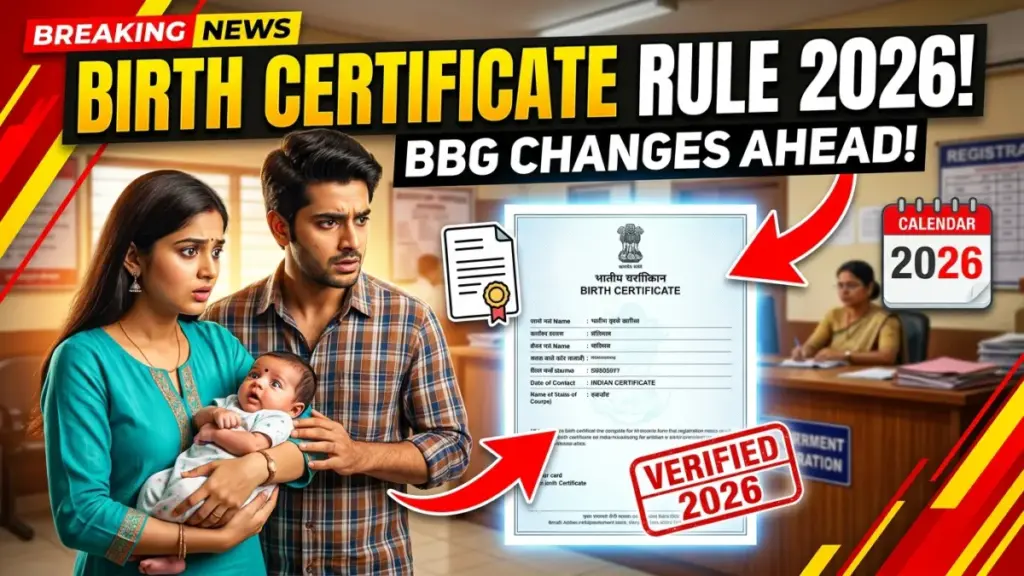
2Birth Certificate New Rule 2026: India’s civil registration system is undergoing a procedural refinement in 2026 aimed at improving the accuracy of foundational identity records. Birth registration has long been mandatory under the Registration of Births and Deaths framework, but authorities are now introducing an additional verification stage before the final certificate is issued. According to reports and administrative briefings, the change focuses on confirming information submitted during the registration process rather than altering the legal obligation to report a birth.
The update reflects a broader transition toward digital governance, where official records are increasingly integrated with multiple government databases. Birth certificates serve as a primary identity document used later for school admissions, passports, social welfare schemes and other services. Because of this wide usage, even minor errors in spelling or personal details can create complications years later.

Under the revised approach, parents are expected to verify information entered into the Civil Registration System after hospitals or local registrars upload the initial data. In practical terms, the certificate will be generated only after this confirmation stage is completed. While the new step may appear administrative, policymakers view it as a way to strengthen record accuracy at the earliest stage of a citizen’s documentation lifecycle.
Digital Validation Stage Introduced Before Certificate Issuance
The most notable feature of the 2026 update is the introduction of a digital confirmation process following the registration of a birth. Hospitals and medical institutions will continue to notify local authorities and upload essential details into the Civil Registration System. However, these entries remain provisional until parents review and confirm the information.

According to available documents, the confirmation process allows parents to verify names, dates, gender details and parental identification before the certificate becomes official. Authorities believe that this early-stage verification can significantly reduce clerical mistakes. If confirmation is not completed within the prescribed period, the record may remain pending even though the birth itself has already been reported.
Administrative Reasons Behind Stronger Civil Record Verification
The introduction of an additional verification stage aligns with India’s wider push toward accurate digital identity records. Over the past decade, government services ranging from banking access to welfare benefits have become increasingly connected to identity documentation. In such an environment, inconsistencies between records can create administrative challenges.

A policy analyst familiar with digital governance reforms explains that the birth certificate forms the starting point of a citizen’s official documentation trail. “If foundational records contain errors, those discrepancies may appear repeatedly across systems later,” the expert noted. By strengthening verification at the earliest stage, authorities aim to reduce correction requests that previously surfaced during passport applications or school enrolment procedures.
Timeline Expectations and Possible Late Registration Implications
As per guidelines associated with the revised system, parents are expected to complete the confirmation step within a defined timeframe after the birth is recorded. The exact window may differ between states because local municipal authorities manage operational procedures for civil registration.

Missing the confirmation deadline does not necessarily invalidate the birth record, but it may lead to procedural delays. Authorities could request additional documents, such as hospital discharge summaries or identity proof of parents, to complete the verification stage. Legal professionals note that while late fees may apply in some cases, the more common consequence is extended processing time before the certificate becomes available.
Urban Digital Access Versus Rural Implementation Challenges
The practical experience of the new rule may vary across regions depending on digital access and administrative capacity. In large cities, parents often receive automated notifications through SMS or municipal portals prompting them to validate birth details online. This allows the confirmation step to be completed quickly without visiting government offices.

However, digital literacy and internet connectivity remain uneven in many rural areas. In such locations, families may rely on local registrar offices, municipal counters or community service centres for assistance. According to reports from administrative observers, local governments are expected to provide facilitation support to ensure that the additional step does not discourage timely birth registration.
How the Earlier Birth Registration Process Differed
Before the latest update, the birth registration workflow involved hospitals reporting the birth and registrars issuing the certificate after processing the entry. Parents typically provided information during the initial reporting stage, but there was limited scope for verification once the certificate had been generated.

This earlier system often resulted in correction requests months or even years later. For example, a spelling mistake in a parent’s name might remain unnoticed until a passport application required strict document matching. Correcting such errors could involve affidavits, legal declarations or repeated administrative visits. The 2026 confirmation step aims to address such issues before the certificate becomes part of the permanent record.
Important Clarifications for Parents Completing Registration
Officials have clarified that the digital confirmation requirement does not replace the existing obligation to report a birth within the statutory timeline. Hospitals, midwives and local authorities will continue to record births in the Civil Registration System as soon as possible after delivery. The new requirement only affects the final certificate issuance stage.
Parents are encouraged to review all details carefully during the confirmation process, particularly spellings of names and date entries. In practical terms, keeping hospital records and identification documents readily available may help resolve discrepancies quickly. Verification with the local municipal corporation, gram panchayat office or registrar of births is recommended because procedural timelines and digital platforms may differ across states.
Disclaimer: This article is intended for informational purposes based on currently available policy updates and administrative guidance regarding birth registration procedures in 2026. Implementation details, confirmation timelines and associated fees may vary by state or local authority. Readers are advised to verify the latest procedures through official municipal portals or the office of the registrar of births and deaths before completing registration or documentation.