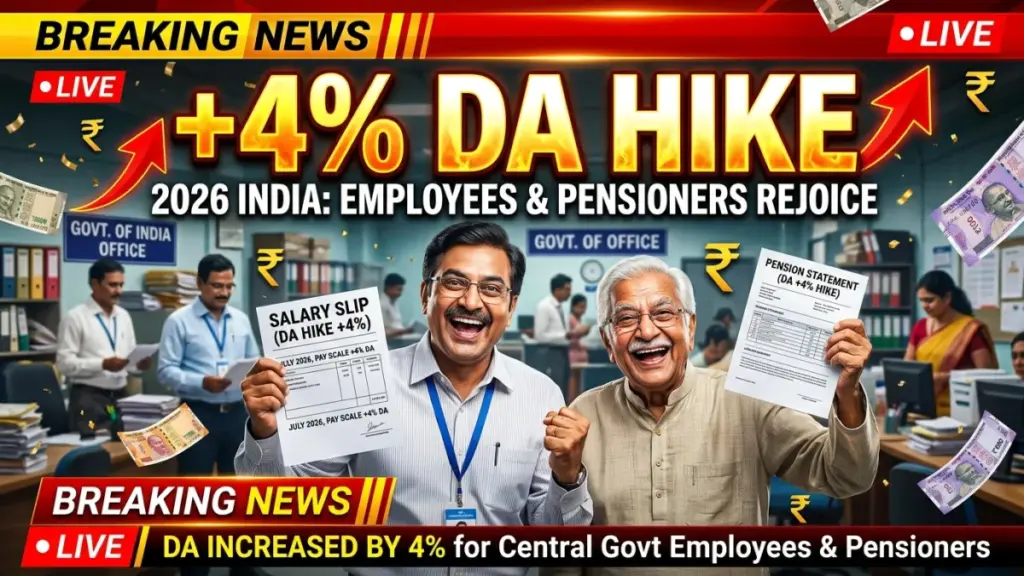
The Central Government has approved a 4% increase in Dearness Allowance (DA) for serving employees and Dearness Relief (DR) for pensioners in 2026, pushing the total DA rate to 60% of basic pay. The adjustment is part of the existing salary framework designed to offset the impact of rising living costs. With expenses such as food, transport, school fees, and healthcare continuing to climb in many cities, the revision may offer modest financial support to millions of employees and retirees.
Dearness Allowance functions as a cost-of-living adjustment rather than a fixed bonus. Its purpose is to help maintain purchasing power when inflation affects household spending. For pensioners, the equivalent support is Dearness Relief, which is calculated on basic pension. According to reports, the latest revision will apply to central government employees and pensioners covered under the current pay structure. While the percentage increase appears limited, the actual amount added to monthly income depends on the individual’s basic salary or pension.

In practical terms, the announcement arrives at a time when many households are reviewing budgets as the financial year approaches its end. For government staff and retirees, even incremental changes in allowance components can influence spending plans, loan repayments, or savings contributions.
Inflation Index Formula Behind Dearness Allowance Revisions
Dearness Allowance adjustments follow a formula linked to the All-India Consumer Price Index for Industrial Workers (AICPI-IW). This index tracks changes in the cost of everyday goods and services, including food items, clothing, housing, and transportation. The system ensures that salary revisions are connected to measurable economic data rather than discretionary decisions.

The framework currently operates under the 7th Pay Commission recommendations introduced in 2016. As per guidelines, DA revisions typically occur twice a year when inflation trends justify adjustments. When the consumer price index shows sustained growth, the allowance percentage is revised upward to compensate for rising living costs. This process helps maintain the real value of wages, though the exact revision size depends on inflation data during the relevant period.
How the 4% Increase Translates Into Monthly Income
The practical impact of the DA hike depends largely on an employee’s basic pay. Since the allowance is calculated as a percentage of basic salary, higher pay levels result in a larger absolute increase. For example, an employee with a basic salary of ₹50,000 may see an additional ₹2,000 per month after a 4% rise. Over the course of a year, this could amount to around ₹24,000 before tax deductions.

Pensioners receive Dearness Relief using a similar calculation method. A retiree drawing a basic pension of ₹30,000 may receive approximately ₹1,200 extra per month under the revised rate. While these increments may not dramatically change financial planning, they can assist with recurring expenses. A retired administrative officer in Lucknow noted in a conversation that incremental DA revisions “help absorb gradual increases in medical costs and daily living expenses.”
Financial Year Timing and Possible Arrears Payments
In several past revisions, the government announced DA increases after the effective date had already passed. When this occurs, employees and pensioners may receive arrears covering the months between the effective date and the formal announcement. According to available information, whether arrears are paid in 2026 will depend on the specific implementation order issued by the relevant department.

If arrears apply, the payment is usually credited as a lump sum in salary or pension accounts. Such payments may provide temporary liquidity, helping households cover large expenses or savings commitments. However, the actual amount varies widely depending on pay scale and service category. Employees are generally advised to wait for official salary statements before making financial plans based on anticipated arrears.
Tax Planning Considerations Linked to Higher Allowances
Although Dearness Allowance increases monthly income, it is also considered part of taxable salary. As a result, employees whose annual income moves closer to a higher tax slab may need to review their financial planning. In practical terms, the additional income could slightly raise overall tax liability depending on deductions and exemptions claimed.

Chartered accountants often recommend revisiting tax-saving investments when salary components change. Contributions under sections related to retirement savings, insurance premiums, and medical coverage may help balance the tax impact. “A DA increase improves take-home income but employees should reassess deductions to keep tax exposure manageable,” explained a Mumbai-based tax consultant familiar with government salary structures.
Role of DA Levels in Future Pay Commission Discussions
Historically, when Dearness Allowance rises significantly over several years, it sometimes becomes a factor in broader salary revision discussions. In earlier pay commission cycles, accumulated DA was occasionally merged with basic pay when a new pay structure was introduced. Such decisions are part of comprehensive salary reforms rather than routine allowance revisions.
At present, the latest 4% increase appears to be a continuation of the existing framework rather than a sign of an immediate structural change. Policy discussions about a potential future pay commission periodically emerge in administrative circles, but no formal announcement has been issued so far. Based on available information, incremental DA revisions are expected to remain the primary mechanism for adjusting salaries to inflation in the near term.
Coverage Scope and How Employees Can Confirm Updated Figures
The revised Dearness Allowance applies to central government employees and pensioners whose pay structures follow the 7th Pay Commission guidelines. State government employees may receive similar revisions, but those depend on individual state notifications. Public sector undertakings and autonomous institutions sometimes follow separate compensation frameworks, meaning the timing and percentage of DA revisions may differ.
Employees who want to verify their updated salary calculations can check official office memorandums issued by the Department of Expenditure or access payroll portals used by their departments. Pensioners may confirm revised Dearness Relief through bank statements or communications from pension disbursing authorities. Verification is recommended before assuming final amounts, as calculations may vary by pay level and service category.
Disclaimer: This article is intended for informational purposes based on publicly available details regarding Dearness Allowance revisions for central government employees and pensioners. Exact implementation dates, arrears payments, and calculation outcomes may vary depending on official government notifications and individual pay structures. Readers are advised to consult departmental circulars, payroll statements, or financial advisors for accurate guidance regarding their salary or pension benefits.